Scottish History of Dunedin

Scottish-Pipe-Band.jpg
Scottish-Dancers-2025.jpg
Scottish-Piper.jpg
Scottish-Dancers-2-2025.jpg

Scottish Settling of Dunedin

Did you know the Dunedin area was originally named Jonesboro by George L. Jones, the owner and operator of a local general store?  

When Scottish merchants John O. Douglas and James Somerville came to the area and opened up a general mercantile business in 1882, they petitioned the government to open a post office. The post office, followed by the town itself, was named Dunedin after the Gaelic Dùn Èideann, which means "castle on the rock."

Although not a prevalent part of its early days, Dunedin grasped onto its Scottish founding by naming roads and neighborhoods like Scotland Street, Louden Avenue, Highland Avenue, Locklie Street, Aberdeen Street, Beltrees Street, Brae-Moor, Loch Lomond, Lake Highlander, and Stirling Heights.

Piping in Dunedin

While building its new junior high school in 1957, Dunedin named the school Dunedin Highland Junior High (now middle school) in homage to its Scottish heritage. Future Dunedin Mayor Robert Longstreet, with the help of Scottish Lord Thomson, donated two bagpipes to the school, making them the most unique band in Florida. Soon, the band’s booster club was able to raise enough money to pay for instruments to create a special pipe and drum band.

Dunedin Junior High School Pipe Band

Local piper David Watson was able to get the bagpipes in working order, and later, pipe master from Scotland and Dunedin resident Matt Forsythe assisted students in learning the bagpipes. The Dunedin Junior Highlanders then became a hit.

To put Scottish culture on full display, Mrs. McLean taught the majorettes authentic Highland Dance to perform alongside the band. Bagpipes and "Scotland the Brave" then spread to the high school, and the City of Dunedin Pipe Band was created as an outlet for young and older adults to keep the art of piping alive. The Dunedin Highland Games and Festival Committee was formed in 1967 to support the pipe bands to travel and perform this piece of Dunedin’s heritage.


Dunedin Coat of Arms & Tartan

To display its Scottish heritage, the City of Dunedin became a Sister City with Stirling, Scotland, and Summerside, Prince Edward Island, Canada, On on June 15, 1964, and then April 20, 2000, respectively. Both cities created this link with Dunedin as Scottish cultural exchanges and to further the City’s commitment to and preservation of its Scottish Heritage.

In 1964, the Dunedin Council of Organizations began to look for a unifying logo. Two Dunedin High School students created Dunedin’s current Coat of Arms, which takes several objects from Scottish Heritage. Located in the center is a staff reminiscent of marching bands in Scotland. Tartan from the Clan Eliot is used in the Coat of Arms. 
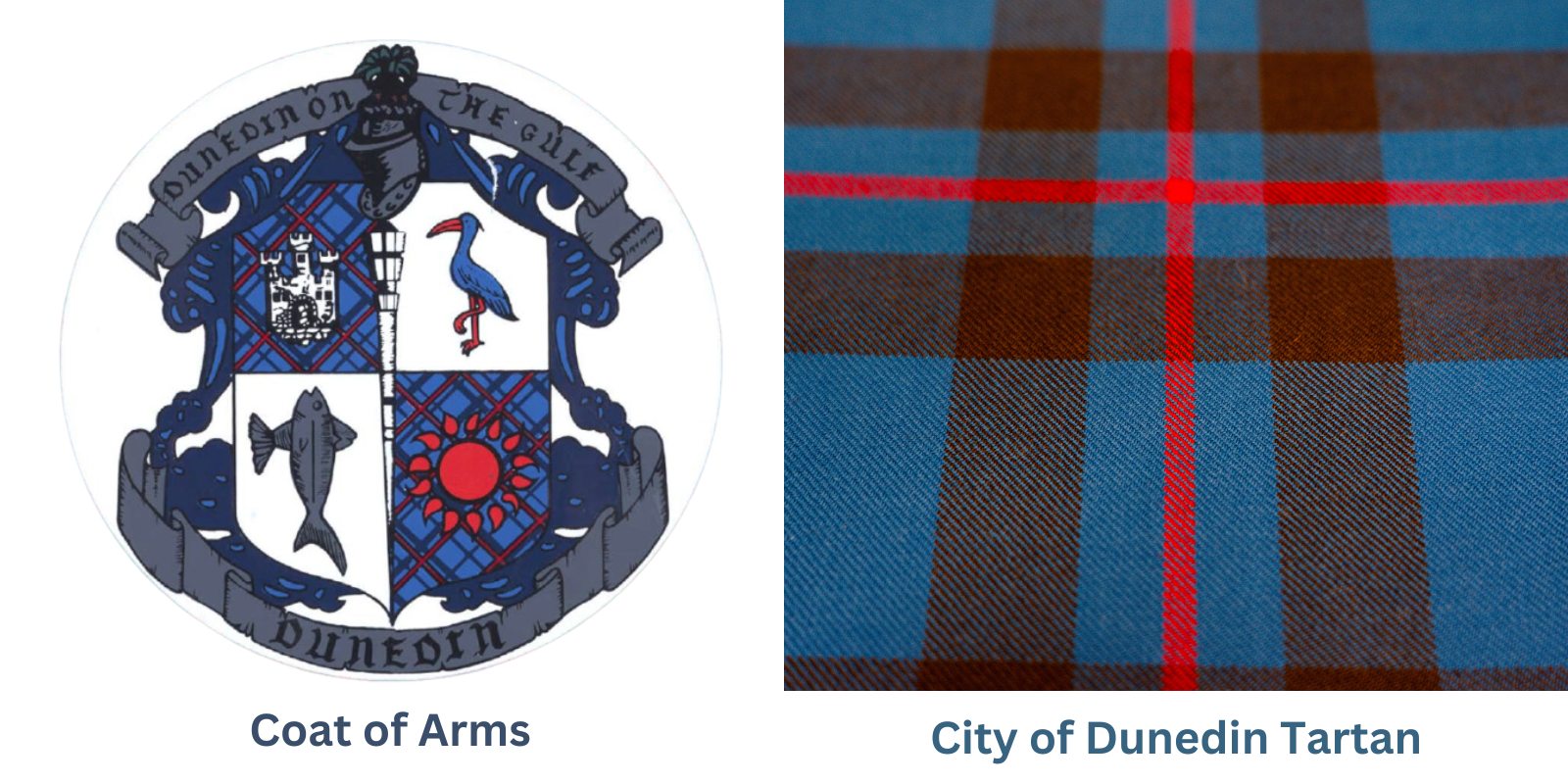
Dunedin’s registered tartan was designed in 1986 by Mr. Matthews to be similar to the Edinburgh District Tartan with colors that represent the City.

Today, Dunedin is well known locally and internationally for the events, organizations, businesses, restaurants, breweries, bagpipers and highland dancers that support and embrace the City's Scottish roots.


Dunedin's Highland Games

The Dunedin Highland Games and Festival began in 1967 and has become Florida's largest and oldest continuous Highland Games. Today, the festival has grown to include the Florida Open Dance Championship, the Hiram Walker Florida Pipe Band Championship, and the U.S. National Masters Athletic Competition, attracting athletes from all over the United States.

The Dunedin festival features competitions in piping, dancing, drumming, and in "tests of strength" games, which include caber tossing, weight throwing, hammer throwing, and shot putting. Winners go on to compete at state, regional, national and international games. World championships are held in Scotland. A military tattoo, which includes several pipe bands from the local schools, is also part of the festivities, as well as Scottish storytelling and sheepdog demonstrations.

Learn more from the Dunedin Scottish Arts Foundation


Scottish American Society of Dunedin


The Scottish American Society of Dunedin began as a social club in the late 1970s, to celebrate and carry on Scottish traditions in Dunedin. Their mission is to preserve, teach, and honor the culture, traditions, and history of Scotland through various activities, events, and programs for the community. 

The Scottish American Society of Dunedin is located at 917 Louden Avenue at the Scottish Cultural Center, in the first designated historic landmark in Dunedin, built in 1940 as an annex to the City's Old Red Brick Schoolhouse.

Today, the Scottish American Society organizes cultural seminars and educational programs to teach bagpiping, highland dance, Scottish country dancing, and a genealogy work group. They also put on whisky tastings, Celtic music concerts, and celebrate Scottish holidays.


National Tartan Day

Tartan Day began in Canada with a proposal from the Federation of Scottish Clans in 1991. As a result, they petitioned the United States and they formally recognized it in 1998. 

Tartan Day is celebrated on April 6 to commemorate the Declaration of Arbroath in 1320, the document that gave Scotland full sovereignty and gave the citizens more rights and freedoms. This document later became one of the templates used in drafting the American Declaration of Independence.

Learn more about National Tartan Day.