Slow Down, Look Around: Staying Safe at Crosswalks
Published on May 13, 2026
Written By: Kathy Gademer, Community Development Project Manager
Every day, people walk, bike, and drive on the streets of Dunedin. Because everyone shares the road, individual choices, especially about speed and attention, have a direct impact on how safe those streets are. One of the most important factors is vehicle speed, which influences both how likely a crash is and how severe the outcome will be.
Vision Zero is a safety approach built around one core idea: traffic deaths and serious injuries are preventable, not inevitable. It recognizes that humans will make mistakes, so the transportation system should be designed and managed in a way that keeps those mistakes from leading to fatal or life‑changing crashes. In practice, this means focusing on safer speeds, safer street design, and better awareness among all road users.
Speed Plays a Crucial Role in Crash Severity
Research shows that if a car strikes a pedestrian at 20 miles per hour, there is roughly a 10 percent chance of a pedestrian fatality. At 40 miles per hour, the chance of death rises to about 80 percent. That change is not linear; doubling the speed results in a far greater increase in risk. This is why relatively modest reductions in speed can significantly improve the chances that someone survives a collision.
Speed Affects the Distance Needed to Stop
A driver must first perceive a hazard and react, then the vehicle needs additional distance to brake to a full stop. On a dry roadway, approximate stopping distances are about 110 feet at 20 miles per hour, 190 feet at 30 miles per hour, and 285 feet at 40 miles per hour. Those distances are long enough to span several rows of parked cars. As speed increases, both the thinking distance (while the driver reacts) and the braking distance grow, so the total stopping distance rises quickly.
Stopping Distance and Road Surface Conditions
On wet or rainy pavement, tire grip (friction) is reduced, which increases braking distance.
Many safety analyses and tire studies note that wet roads can lengthen stopping distances by about one and a half (1.5 times ) to two times (2x’s) compared with dry conditions. This means a driver who could stop in time on a dry street may not be able to do so on a wet one when traveling at the same speed. As a result, both speed choice and road conditions matter when evaluating risk at crosswalks and intersections.
Different types of roads create different conditions for people walking or biking. Local neighborhood streets tend to have fewer lanes and lower speeds. In contrast, multilane arterials and highways carry faster traffic and often have wider crossings. Crossing a two‑lane street can usually be done more quickly, which reduces the time a pedestrian is exposed to moving traffic. Crossing a six‑lane road often takes longer and can involve vehicles moving at higher speeds, which increases both exposure time and the potential severity of a crash if something goes wrong.
Pedestrian Crosswalks
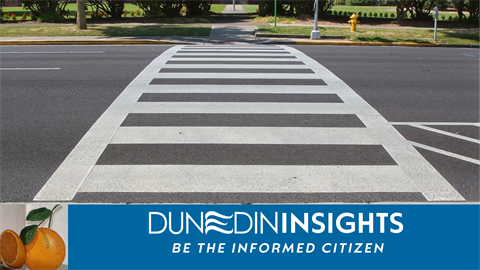
Crosswalks are places where pedestrian crossings are expected and sometimes controlled by signs or signals. Drivers know where to anticipate pedestrians, and pedestrians have a designated space to cross.
However, crosswalks are not guaranteed spaces of safety. They work best when road users understand and follow basic rules—drivers approach crosswalks at appropriate speeds and prepare to yield, and pedestrians enter the crosswalk by looking both ways, only when it is safe and they are fully attentive.
Speed and Crosswalk Visibility
Visibility is another critical element of crosswalk safety. The concept of a “sight triangle” helps explain this.
At an intersection, there is an area extending out from the corner along each roadway where people need a clear line of sight to see and be seen. If this area is blocked by parked vehicles, dense vegetation, or large signs, drivers may not see pedestrians in time, and pedestrians may not have a clear view of approaching vehicles. Poor sight distance reduces the time available to make safe decisions and increases the chance of conflicts.
Simple Habits Can Reduce Risk for All Road Users
Pedestrians who pause at the curb, scan for traffic in all directions, and make eye contact with drivers improve their chances of being noticed.
Cyclists who follow traffic controls and use lights or reflective gear in low‑light conditions increase their visibility, making it easier for drivers to detect them early.
Drivers who slow as they approach intersections and crosswalks, scan for pedestrians and cyclists, and anticipate that someone may step into the road are better able to respond in time.
Ultimately, crosswalk safety depends on awareness, judgment, and respect among all road users. Understanding how speed, stopping distance, visibility, and road design interact can help individuals make safer choices. Slowing down, paying attention, and recognizing the limits of both human reaction time and vehicle performance are key steps toward reducing serious crashes and supporting the broader goal of safer streets for everyone.